
DEEP DIVE
How Many Swimming Pools Are Too Many for Byron?
Seventeen swimming pool applications in a month. One property with three pools. And a possible Super El Niño summer approaching. At what point do we start asking whether Byron has enough water to keep filling them?
Information from Planning Alerts shows 17 applications for new swimming pools within a 2km radius of Byron Bay in the past month.
Recently Mayor Sarah Ndiaye spoke about the possibility of a drier summer and potential water restrictions. Meanwhile, private pools — including rooftop pools and pools attached to increasingly high-end developments — continue to grow.
The question isn't whether people should be allowed to have a swimming pool. It’s how many are too many for a town without its own water supply. What is the capacity and does Byron have a finite water supply?
Byron isn't the only tourism destination asking the question
What lessons could we learn from Greece?
Across the Greek islands, communities are confronting what happens when tourism, development and water demand collide.
On Lipsi, authorities banned the construction of new swimming pools in 2023. On Karpathos and Serifos, restrictions have been imposed on topping up pools during water shortages. In Crete, the municipality of Viannos has prohibited the use of drinking water to fill swimming pools, including existing pools. And in parts of Santorini and Therasia, building restrictions have specifically included new swimming pools and hot tubs.
These aren't all the same measures, and Greece isn't Byron Bay. But the underlying issue is familiar.
Water is finite, and development creates demand. At some point, planning has to consider the cumulative impact of thousands of individual decisions.
Perhaps Byron should be asking the same questions.
One pool is one pool. In context it is something else.
A swimming pool can seem like a minor planning matter: one property, one application, one approval.
But what happens when there are dozens?
What happens when pools are being dug into the water table — much of Byron being essentially swamp — alongside hundreds of new dwellings, larger houses, increased visitor numbers and more intensive development?
This is where cumulative impact matters.
Byron's urban water comes through the regional Rous system, and Byron Shire's share of the bulk-water cost is around $6.9 million a year. Developers contribute to water infrastructure through development charges, but those charges aren't a prepaid allocation of water for every new pool.
At EADE on Shirley Street, a 25-apartment luxury development includes a communal resort pool, while marketing material promotes private pools for most garden residences and private plunge pools on all 10 rooftop residences — potentially more than 10 - 15 pools on one site.
But perhaps the number of pools tells us something else too. Byron Bay is heading towards gentrification — of the fast and furious kind.
It’s a visible marker of the changing nature of development in Byron — more luxury, more private amenities and a wealthier demographic shaping what gets built and what is considered “normal”. The pool is increasingly part of the package of a high-end, resort-style development.
Like the State Significant Developments, Byron can't afford to treat every pool as an isolated application. There are many in the broader Shire who are concerned with some asking for a moratorium on development so we can gain a clear picture of capacity,on sewerage/water/traffic infrastructure and assess the changing character of our built environment?
What kind of town are we building?
Let's be honest, even the pool industry acknowledges that swimming pools aren't exactly eco-friendly. They can be significant users of water and energy through pumping, filtration, heating and evaporation.
Sure there are ways to make pools more sustainable — but efficiency doesn't remove the bigger question: how much water can Byron sustainably allocate to private amenities as development continues to grow?
Byron Shire markets itself on its beaches, waterways, natural environment and laid-back coastal lifestyle. Yet increasingly, developers are building ultra-luxury projects with the expectations of a resort: rooftop pools, plunge pools, wellness amenities, saunas and ice baths galore.
For a moment during Covid, many thought perhaps that event might allow developers and investors to see the reality of Byron’s constraints and beauty - a small regional town built on floodplains, but surrounded by the natural environment.
The community has spent decades fighting to protect the low-key, low-rise vibe creating a distinctive character. We need the Council to be pro-active of the changes in development and demand better planning and more sustainable development. And question the assumption that having a swimming pool on top of every hotel or in every backyard is a sacred-right.
These 17 applications are for properties within walking distance of some of the best beaches in the world. Crazy.
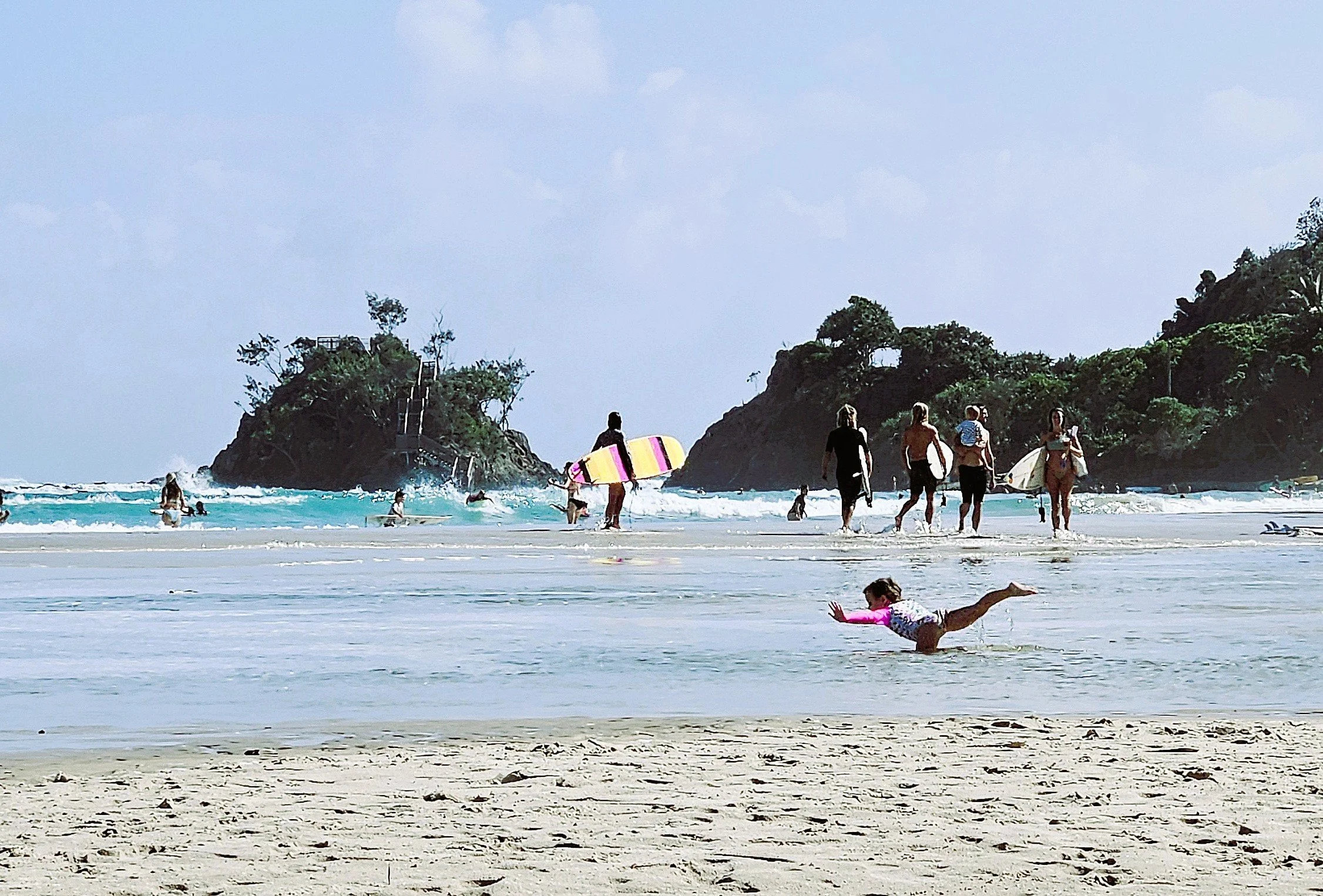
Luxury isn’t another pool …
it’s the joy and simple beauty of our beaches.
Isn't that what Byron is supposed to be about?